

Content
- TalentDesk vs Worksuite at a Glance
- Contractor and Freelancer Management
- Vendor and Subcontractor Visibility
- Projects, Tasks, Time and Budget Management
- Contractor Compliance and Classification Support
- Global Contractor Payments
- TalentDesk vs Worksuite Pricing
- How to Choose Between TalentDesk and Worksuite
- The Bottom Line
- Frequently Asked Questions
If you are evaluating contractor management platforms, TalentDesk and Worksuite will likely both appear on your shortlist. Both handle global contractor onboarding, compliance, and payments. Both cover 190+ countries. Both offer Agent of Record (AOR) services.
But the two platforms take different approaches to external workforce management. Worksuite is an enterprise freelancer management system with particular strengths in configurable talent networks, white-label experiences, compliance services, and payment operations, and has a strong presence in creative and media industries. TalentDesk connects contractor and vendor onboarding, work allocation, project and budget control, compliance, invoicing, and global payments in one platform, making it particularly relevant for businesses that want operational and financial visibility across the external workforce lifecycle.
This comparison breaks down where each platform is stronger across the six capabilities that matter most.
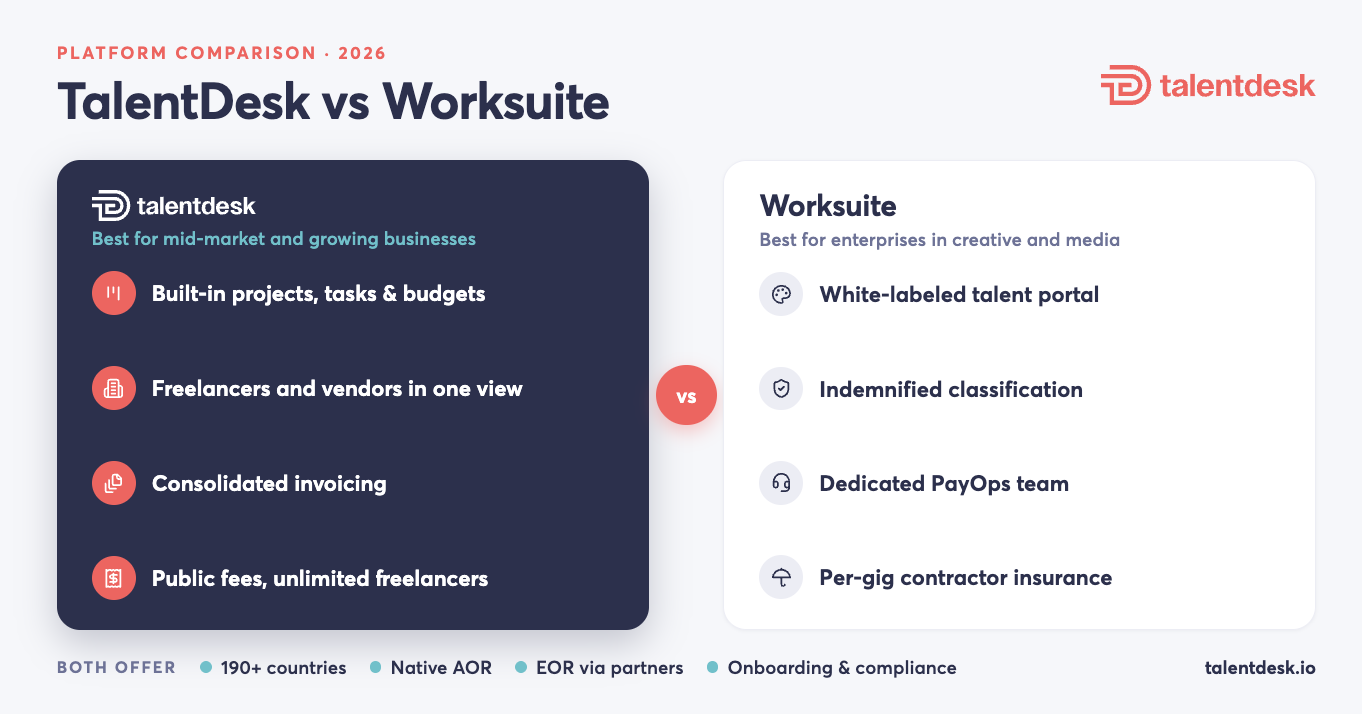
TalentDesk at a glance: Global contractor management and payment platform. Built for businesses managing contractors across multiple geographies. Strong project and task management layer on top of compliance and payments. AOR natively. EOR via Atlas partnership.
Worksuite at a glance: Enterprise freelancer management system (FMS) with a strong presence in creative, media, and publishing. White-labeled talent portal. Dedicated PayOps support team. AOR services and an integrated Contingent EOR offering delivered through in-country partners.
TalentDesk vs Worksuite at a Glance
|
Capability |
TalentDesk* |
Worksuite* |
|---|---|---|
|
Contractor onboarding and profiles |
Yes |
Yes |
|
Private talent pool / contractor database |
Yes |
Yes, white-labeled |
|
Project, task, and budget management |
Yes |
Yes |
|
Vendor and subcontractor visibility |
Yes |
Yes |
|
Worker classification and compliance |
Yes |
Yes, indemnification-backed |
|
AOR (Agent of Record) |
Yes, native |
Yes, native |
|
EOR (Employer of Record) |
Yes, via Atlas |
Yes, integrated via in-country partners |
|
Global payments |
190+ countries |
190+ countries, 120+ currencies |
|
Dedicated contractor payment support |
Customer success and support |
Yes, dedicated PayOps team |
|
White-labeled portal |
No |
Yes |
|
Per-gig contractor insurance |
No |
Yes |
|
Public pricing structure |
Partial: transaction fees published; platform plans quoted |
No, custom quote |
|
Best for |
Mid-market and growing businesses |
Enterprises in creative and media |
*The information was checked in October 2026. Features and prices may change.
Contractor and Freelancer Management
Both platforms handle the full onboarding and management lifecycle for independent contractors. You can build a searchable talent database, collect tax and banking details, manage contracts, and track engagement history.
Worksuite goes deep on the talent pool infrastructure. Their private talent network is white-labeled end to end: contractor-facing portals, notifications, and onboarding flows carry your brand, not Worksuite's. Freelancers manage their own profiles, update availability up to 12 weeks in advance, and self-onboard via shareable links. The platform was built around large creative organizations running high volumes of talent across multiple brands simultaneously, and that focus shows in the product.
TalentDesk covers the contractor lifecycle through automated onboarding, centralized profiles, compliance workflows, project and task management, invoicing, and payments. The platform is designed to connect the operational and financial sides of external workforce management, so teams can manage contractors and their work without separating workforce records from project delivery and payment workflows.
The meaningful difference is emphasis. Worksuite places particular weight on configurable private talent networks and white-label contractor experiences. TalentDesk places greater emphasis on connecting contractor management with projects, tasks, budgets, invoicing, payments, and wider external workforce operations. The better fit depends on which of those capabilities is most important to your operating model.
Vendor and Subcontractor Visibility
Managing relationships with vendors, agencies, and subcontractors alongside individual contractors is a common operational challenge. You need to know what work is assigned, what is outstanding, and what has been approved, across the entire supplier layer.
TalentDesk provides dedicated vendor and subcontractor visibility that gives finance and operations teams a clear view of the full supplier mix. You can track engagement status, outstanding deliverables, and spend across individual contractors and external vendor organizations from one dashboard. For businesses that rely on a combination of freelancers and agency relationships, this is an important operational capability.
Worksuite also supports vendor-related workflows, including vendor-level budget tracking, invoice management, and small-vendor management through its AOR services. TalentDesk's approach is particularly useful for teams that want contractors and external vendor organizations connected to project delivery, tasks, budgets, approvals, invoicing, and payments in the same operational environment.
Projects, Tasks, Time and Budget Management
A contractor management platform that cannot track what contractors are actually working on creates a gap between the compliance layer and operational reality. The best platforms connect contracts, work assignments, timesheets, and budget in one record.
TalentDesk has a full project, task, and budget management layer built into the platform. Project managers can assign tasks directly to contractor profiles, track deliverables against what was agreed in the contract, monitor real-time budget spend, and approve timesheets within the same system. Budget overruns are flagged before invoices are approved. You get a single view of what has been commissioned, what has been delivered, and what is owed, without reconciling across separate tools.
Worksuite also connects work assignments to project budgets and SOW contracts. Fixed-rate, hourly, and milestone engagement types are all supported. Real-time budget tracking and timesheet approval are built into the platform. For creative teams running project-based work, the Worksuite project management layer is solid.
Both platforms handle project-based external work. TalentDesk connects projects and tasks directly with contractor records, budgets, timesheets, approvals, invoicing, and payments. Worksuite supports project budgets, SOWs, fixed-rate, hourly, and milestone engagements, with workflows that are particularly well represented across creative, media, and production use cases.
Contractor Compliance and Classification Support
Compliance is where the real operational risk sits. Misclassification penalties, back taxes, and audit exposure are not theoretical risks. They are outcomes that follow from poor classification and documentation.
Worksuite has built a compliance engine with a meaningful differentiator: indemnification-backed classification decisions. Their Worksuite Classify engine applies federal and local-level classification tests across 190+ jurisdictions, and Worksuite stands behind those decisions. For organizations at enterprise scale with elevated legal exposure, that indemnification backing changes the risk calculus. They also offer audit-ready defense files, per-gig contractor insurance (workers compensation and general liability), and a dedicated compliance team that works directly with your legal and GC teams on complex classification decisions.
TalentDesk provides contractor compliance tools covering onboarding workflows, classification checks, contract management, and AOR services natively. EOR arrangements are available via the Atlas partnership for cases where independent contractor engagement is not appropriate. The platform applies jurisdiction-specific compliance logic at the worker level and maintains a full audit trail across all engagements.
If indemnification-backed classification is a hard requirement, Worksuite has a clear differentiator, subject to the scope and terms of the relevant agreement. TalentDesk combines classification and compliance workflows with native AOR services, while EOR is available through its Atlas partnership. Buyers should compare the level of risk coverage, human support, and contractual protection required for their workforce model.
Global Contractor Payments
Both platforms process payments in 190+ countries. The difference is in the payment operations layer around those transactions.
Worksuite Global Pay processes multi-currency payments with local transfer options in each market. Batch payments are handled in a single click for accounts payable teams. Automated 1099 filing is built in. The standout capability is the dedicated PayOps Support team: Worksuite assigns human payment operations staff who know your contractor program and resolve payment issues directly with your contractors, so payment disputes never bounce back to your internal team. For organizations paying thousands of contractors globally across multiple time zones, this human support layer has real operational value.
TalentDesk covers global payments in 190+ countries with multi-currency processing, automated invoicing tied to approved work, consolidated invoicing, and a full payment audit trail. It also provides customer success and support alongside the payments platform. Worksuite specifically markets a dedicated PayOps team that handles contractor payment operations and queries, so buyers with high payment-exception volumes should compare the precise contractor-facing support included in each service.
TalentDesk's payment model is particularly useful for teams that want approved work, invoices, consolidated billing, and global contractor payments connected in one workflow. Worksuite's dedicated PayOps model may be particularly relevant where contractor-facing payment exception handling is a major operational requirement.
TalentDesk vs Worksuite Pricing
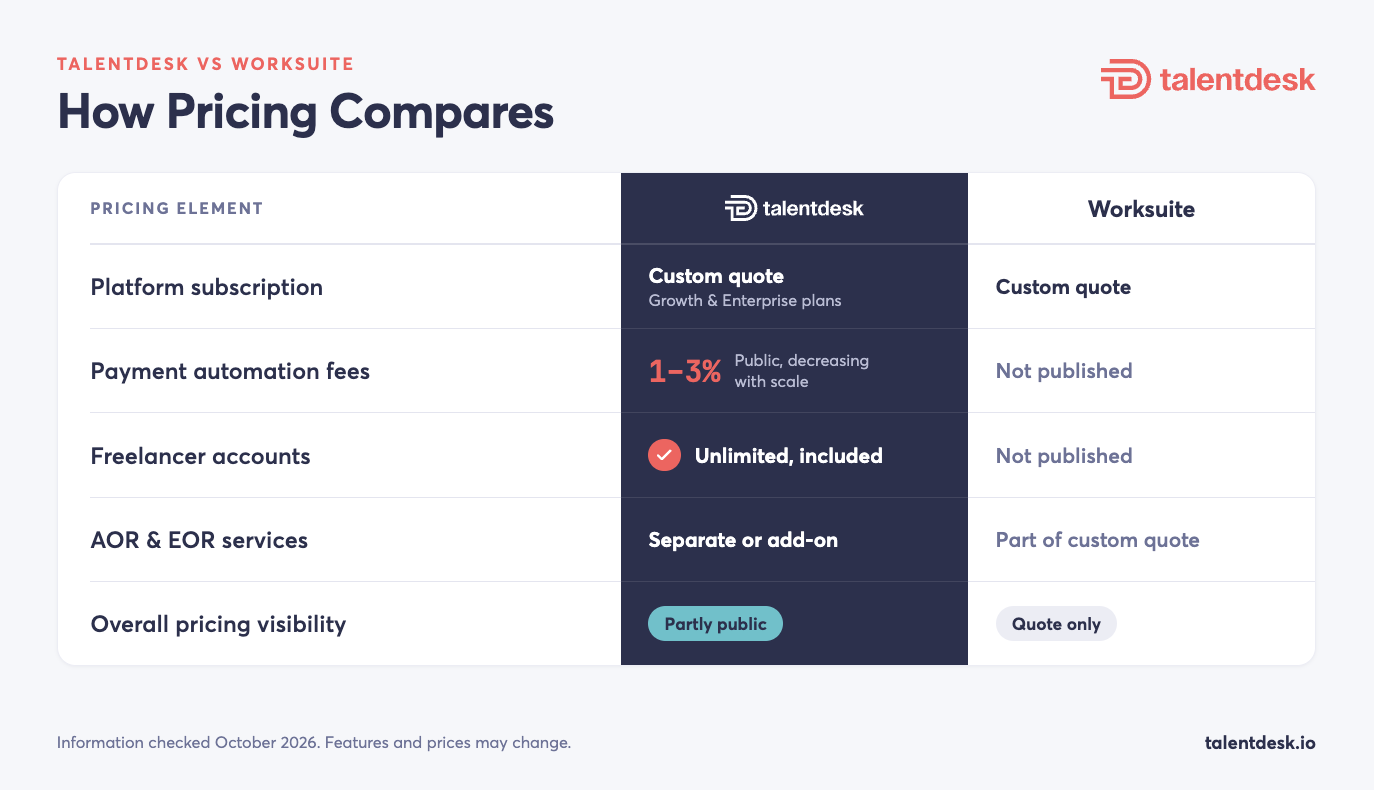
TalentDesk publishes its pricing structure and certain transaction fees. Growth and Enterprise platform subscriptions are custom quoted, while Payments Automation is publicly listed at 1–3%, decreasing with scale. Unlimited freelancer accounts are included, and AOR and EOR services are priced separately or as add-ons.
Worksuite does not publish standard platform pricing publicly and directs prospective customers to request a quote. Because final pricing can depend on program size, configuration, services, and payment requirements, buyers should compare proposals based on their own contractor volumes and required modules rather than relying on third-party pricing estimates.
Pricing should therefore be compared on total program requirements rather than headline platform fees alone. Relevant factors include contractor volume, payment services, AOR or EOR requirements, compliance support, white-label configuration, implementation needs, and the level of contractor-facing support required.
TalentDesk provides more public visibility into its pricing structure and payment automation fees, while both vendors require a quote for core platform pricing. The most useful comparison is therefore a like-for-like proposal based on your workforce size, countries, payment volumes, and required compliance services.
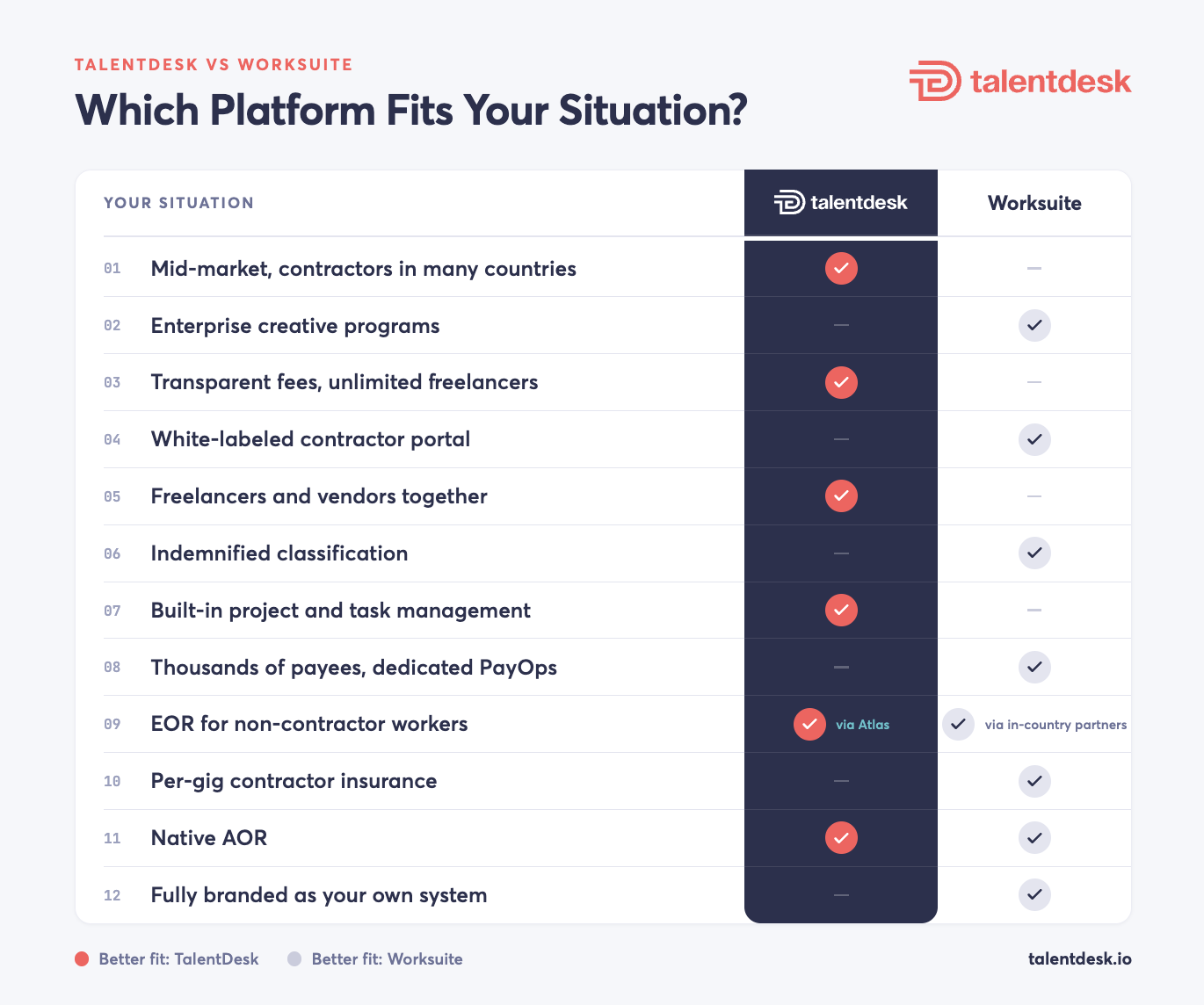
How to Choose Between TalentDesk and Worksuite
The Bottom Line
TalentDesk and Worksuite are both credible platforms for managing a global contractor workforce. The choice between them is less about which platform is objectively better and more about which one is built for your specific situation.
Worksuite is an enterprise freelancer management system with particular strengths in configurable private talent networks, white-label experiences, indemnification-backed classification, and dedicated PayOps support. Its customer base and product positioning show particular depth across creative, media, and publishing environments where organisations may need highly configured freelancer workflows.
TalentDesk is an integrated external workforce management platform connecting contractor and vendor onboarding, compliance, projects and tasks, budget control, invoicing, and global payments. For businesses scaling an external workforce across multiple countries, the value is in keeping the operational and financial lifecycle connected in one system, including consolidated invoicing and unlimited freelancer accounts.
The right choice depends on your operating model. TalentDesk is particularly compelling when connected project delivery, budget visibility, consolidated invoicing, contractor and vendor management, and global payments are central requirements. Worksuite is particularly differentiated where white-label talent experiences, indemnification-backed classification, per-gig insurance, or dedicated PayOps support are priorities.
TalentDesk is a global contractor management and payment platform used by businesses in over 190 countries.
To see how TalentDesk compares for your specific contractor program, request a demo.

Stasha Djokic
Stasha brings over 10 years of experience in digital growth, workforce technology and marketing to her role at TalentDesk, where she creates content that helps businesses better manage vendors, contractors and freelancers. Drawing on her background in growth strategy and external workforce management, she writes about vendor management systems, contractor compliance and the future of work.
See if TalentDesk is the right fit for your external workforce
Related articles

The Ultimate Guide to Freelancer Onboarding in 2026
Learn how to onboard freelancers with a scalable process covering compliance, contracts, payments, onboarding checklists and international best practices.


Behind the Runway: Managing Fashion Week’s Global Contractor Workforce
Fashion Week contractor management made simpler. Manage global freelancers, vendors, contracts, compliance, invoices and payments.

When Contractor Management Breaks: 5 Signs You've Outgrown It
Has your contractor management process stopped scaling? Discover 5 warning signs, what breaks as contractor teams grow, and when it's time to upgrade.

TalentDesk vs Remote: A Contractor Management Platform Comparison
TalentDesk vs Remote: a contractor management platform comparison covering compliance, payments, vendor visibility, and pricing.

The Best Vendor Management Systems (VMS) in 2026
The best vendor management systems (VMS) in 2026, compared by use case, workforce type, and features. Find the right platform for vendors and spend.

Contingent Workforce 101: What It Is, Why It's Growing, and How to Get It Right
Contingent workforce management 101: classification, contractor compliance, and workforce visibility — what it takes to run one program, not ad hoc hiring.

TalentDesk Named Best Freelance Management System by SSR (2026)
TalentDesk has been recognised in the SSR report as a leading freelancer management system. See what earned us the recognition and what it means for our customers.


AI and Compliance: What Companies Need to Know When Using AI to Manage Contractors
Using AI in contractor management comes with real compliance risks. Discover how to stay on the right side of IR35, the EU AI Act, and classification laws.

Freelancer & Contractor Glossary: Every Term You Need to Know
The complete glossary of freelancer and contractor terminology - from work arrangements and tax classifications to compliance and vendor management.


C2C vs 1099 workers: What's the Difference and Which Should You Engage?
Learn the key differences between 1099 and C2C workers, including tax implications, liability, and how to choose the right contractor for your needs.