

Content
- What Freelancer Onboarding Needs to Achieve in 2026
- The Six Stages of Freelancer Onboarding
- Freelancer Onboarding Checklist for 2026
- How Onboarding Changes for International Freelancers
- The Freelancer Experience: Fast Without Becoming Employee-Like
- Common Freelancer Onboarding Mistakes
- What to Look for in Freelancer Onboarding Software
- How to Measure Freelancer Onboarding Success
- Frequently Asked Questions
Freelancer onboarding is the process of verifying, contracting, setting up and preparing an independent professional to begin their engagement with you. Many organizations still treat it as a shortened version of employee onboarding or fail to have a structured process around it. That’s where the problems begin.
In 2026, freelancer onboarding needs to follow one simple standard: You need a repeatable workflow that lets you adapt the process by worker type, country and project, without having to rebuild the process for every engagement. It needs to provide enough context, access and clarity so external workers can start delivering, while remaining independent entities.
|
What Freelancer Onboarding Needs to Achieve in 2026
Freelancer onboarding should be designed to get your freelancers up and running within your system. It should enable you to:
- Engage freelancers compliantly.
- Gather and store all required documentation.
- Set clear project expectations through SOWs.
- Grant freelancers access to the systems they need, without giving them sweeping access.
- Set up payment and invoicing processes, with milestones established.
|
How Onboarding Differs: Freelancers vs. Employees vs. Vendors |
|||
|
Freelancer onboarding |
Employee onboarding |
||
|
Objectives |
Engage, document and set up individual freelancers for specific projects |
Integrate new employees into the organization |
Engage, document and set up vendors and all subcontractors they provide |
|
Training provided |
No |
Yes |
No |
|
Access to systems |
Project-specific |
Comprehensive organizational access |
Project-specific |
|
Payment setup |
Invoicing and payments |
Payroll and benefits |
Invoicing and payments |
Before onboarding freelancers, get internal buy-in on these:
- Get approvals on the business need and budget.
- Define the scope of the project, deliverables, milestones, timeline, rate, currency and payment terms.
- Agree upon the engagement model – whether you want to engage independent freelancers directly, go through a vendor, or engage through an Agent of Record.
- Understand the classification laws that will apply in each case.
- Set approval processes identifying which internal teams will be involved – hiring manager, HR, Legal, Procurement, Finance and IT, and Security.
The Six Stages of Freelancer Onboarding
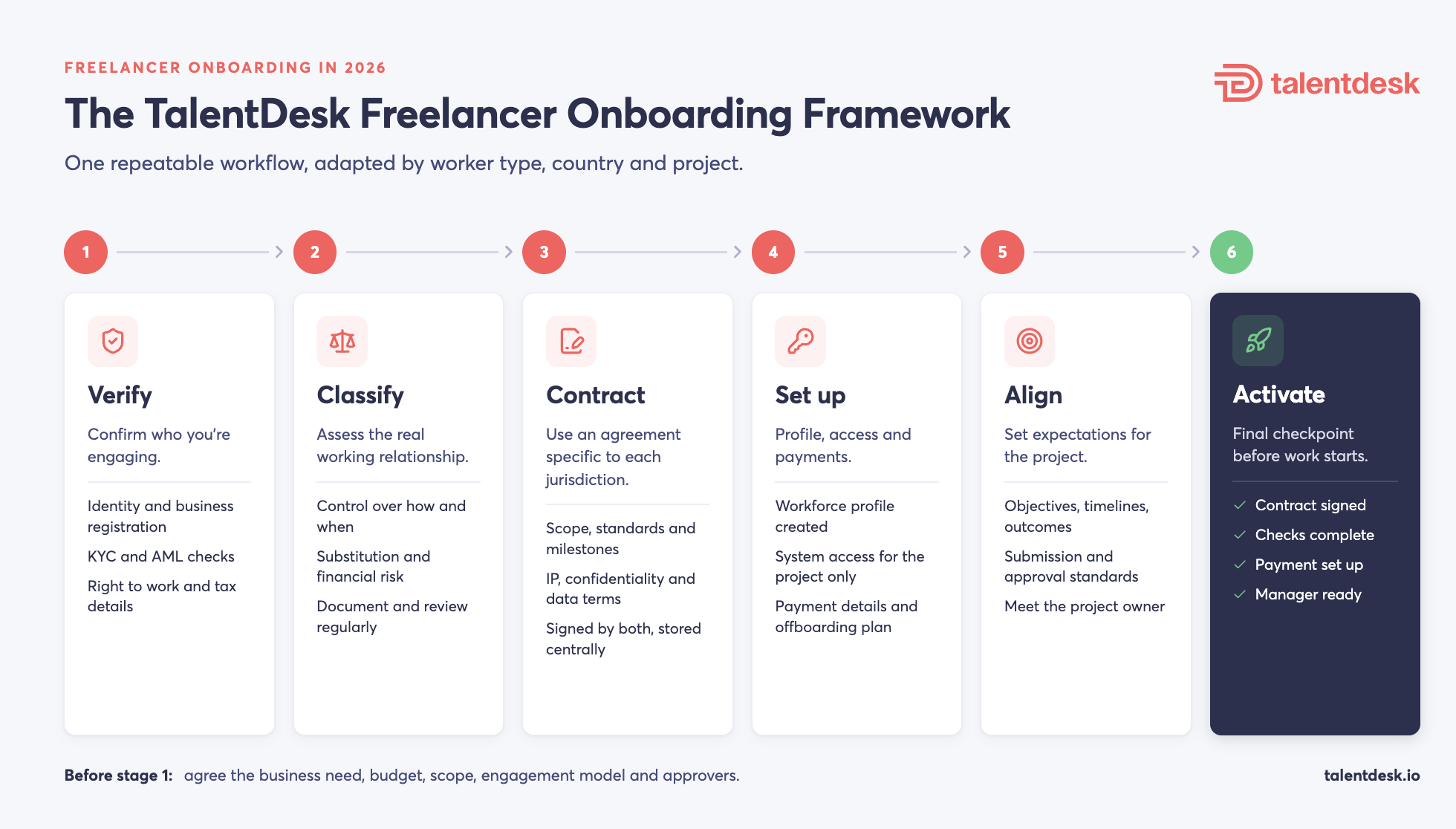
Stage 1: Verify
Confirm and validate the identity of your freelancers. Verify their business registration details (if applicable), gather their self-employment information, and conduct KYC and AML checks. Based on jurisdiction, you may also have to confirm their right-to-work status.
Check your obligations around what tax information you need to collect. Though freelancers file taxes themselves, you may need to record details like their tax documentation number and more.
Point to note: Collect the necessary details – but nothing more! Asking them to submit unnecessary personal information is a compliance failure. Also ensure that the required details, once collected, don’t just live in managers’ inboxes. They must be stored and accessed compliantly as per the data protection laws of each region.
Stage 2: Classify
Assess the working relationship as it plays out in reality. Just having a contract that states a worker is a freelancer is not enough. The authorities will also look at whether:
- The worker can independently decide how and when they will work.
- They must deliver the work themselves or if they can send a substitute.
- They undertake financial risks (as independent professionals must).
- They have access to the same systems your employees do.
- You are their only source of income.
Based on jurisdiction, some of these factors may outweigh others. Record, document and periodically review all these factors that informed the classification decision.
Point to note: This is not a one-time activity. Reassess classification if the project scope, duration, location or work mode changes or if the country’s laws and regulations are updated.
Stage 3: Contract
Using a universal contract template for global freelancers is a big mistake. Contract requirements change from country to country, so a jurisdiction-appropriate agreement is necessary. The contract should cover:
- The actual scope of the engagement.
- Metric-driven standards on what standards the freelancer must meet.
- Payment terms and milestones.
- Jurisdiction-specific rights and liabilities around Intellectual Property (IP), confidentiality and data protection.
- Termination clauses and dispute handling protocols.
The final contract must be signed by both parties and stored centrally.
Point to note: Do not begin any work while the agreement terms are still under negotiation or approvals are pending. This can be a huge compliance risk.
Stage 4: Set Up
Create the freelancer’s profile in your workforce system, give them access to only the relevant data they will need, and set up their details in your payment portal.
Point to note: Freelancers use their own equipment and can work from anywhere they choose, but you may require them to follow certain information security and safety processes as they do so. Take them through these expectations at this stage.
Also ensure there are proper protocols to offboard a freelancer if their contract is not renewed.
Stage 5: Align
While the broader deliverable agreements are covered in the contract, now you can get into the specifics of the project objectives, timelines and outcomes. Ensure the freelancer knows how they must submit the work and what standards they must meet. Introduce them to the project owner and stakeholders, and establish who holds approval authority.
Point to note: Make sure these introductions and integrations are specific to the project. A broader, employee-style induction where they are given an organization-wide view on processes and protocols can lead to misclassification.
Stage 6: Activate
This is the final checkpoint before the engagement begins. Verify that all the previous stages are conducted – the contract is signed, all checks are complete, payment is set up and the manager is ready.
Point to note: Avoid micromanaging freelancers or demanding recurring status updates as these can be seen as asserting an employer-like control. Schedule formal check-ins around deliverables only as agreed in the contract.
Freelancer Onboarding Checklist for 2026
|
Owner |
Onboarding responsibilities |
|
Hiring manager |
|
|
HR, Legal and Compliance teams |
|
|
Finance and Procurement teams |
|
|
IT and Security teams |
|
|
Project Manager |
|
|
Freelancer |
|
Please note: This is an operational checklist and does not replace legal advice. You may need to add jurisdiction-specific processes and protocols as required.
How Onboarding Changes for International Freelancers
Setting a standardized core process is a great starting point. It makes the onboarding workflow repeatable. But keep country-level requirements modular when it comes to onboarding international freelancers.
Based on jurisdiction, you may need to adjust:
- Classification guidelines
- Contract requirements
- Protocols around KYC, data security and privacy laws
- Payment requirements and bank information to be collected
- Tax form details and reporting timelines
Formalizing these country-specific workflows is crucial. Not every manager may remember the different protocols or know the implications of each rule.
Point to note: Where a freelancer actually works from is significant – not just their nationality or banking country. That’s because when data and information crosses borders, they may be governed by different privacy laws and security requirements. Their contract needs to be built around this.
An Agent Of Record (AOR) can be immensely helpful in managing freelancer classification, contracting and onboarding across countries.
The Freelancer Experience: Fast Without Becoming Employee-Like
A great onboarding process is one that’s clear and respectful for the freelancer and efficient and compliant for your business. It needs to be:
- Speedy: Freelancers shouldn’t have to wait weeks before they can start work.
- Streamlined: There should be one centralized location where freelancers can submit information and view onboarding status. Having different teams reaching out for the same details causes unnecessary friction.
- To-the-point: Communication to freelancers should be relevant to the project and engagement. They should not be sent company-wide memos or notifications.
- Transparent and non bureaucratic: Clear workflows should be established at the start, with quick support available where needed. Freelancers should not have to follow up with multiple people to get work or invoice approvals!
Common Freelancer Onboarding Mistakes
-
Allowing work to begin before the contract is signed.
Getting the freelancer familiarized with the project while you wait for internal approvals may seem harmless or even efficient – but it can lead to compliance issues.
How to avoid this: Begin work only after the 6 stages of onboarding have been officially completed and the contract is signed. - Using the same onboarding workflow in every country.
Missing out important jurisdiction-specific classification questions, contract clauses or documentation protocols may lead to misclassification and disputes.
How to avoid this: Have country-specific workflows formalized and made easily accessible to managers across the organization. AOR services can be valuable, especially if you are working with large talent pools across many regions. - Treating the freelancer as an employee in company systems.
Innocent actions like adding freelancers to company-wide communication channels or asking them to log their availability can be seen as disguised employment.
How to avoid this: Train managers to understand the implications of these actions. Use a freelancer management system with strong guardrails and have periodic reviews to assess the actual working relationship with freelancers. - Collecting documents through unsecured email chains.
Freelancers’ personal details casually gathered through emails or communication apps can open up grave data privacy and security breaches.
How to avoid this: Have a centrally managed onboarding process and a single, secure platform that all managers and freelancers use, every time. - Failing to connect onboarding with payment setup.
Last-minute payment issues or delays after the work is done opens up unnecessary disputes, dissatisfaction and contract failures at your end as the client.
How to avoid this: Make payment setup a part of the freelancer onboarding process, and automate invoice processing so there are no manual errors or bottlenecks. - Giving excessive system access or forgetting an end date.
Without proper offboarding, freelancers end up having access to your data long after their contract has ended, because nobody thought to revoke it.
How to avoid this: Schedule recontracting reminders on your freelancer management platform. If you choose not to re-engage the freelancer, trigger the process to formally offboard them. - Leaving all responsibility with the hiring manager.
This leads to process fragmentation and compliance failures, with each manager onboarding as per their discretion.
How to avoid this: Formalize processes in collaboration with HR, Legal, Accounts and Hiring teams. Here again, a freelancer management platform helps maintain consistency and accountability. - Rebuilding forms and approvals for every engagement.
Reinventing the wheel as you onboard each new freelancer creates delays and places a huge operational burden on your internal resources.
How to avoid this: Have a repeatable process where you can automate all the steps possible while keeping humans in the loop for necessary approvals and judgement calls.
What to Look for in Freelancer Onboarding Software
- Customizable onboarding templates and forms.
The software should let you integrate data and steps as per your organization’s requirements and preferred work models. - Conditional workflows by country, team or worker type.
It should have the capability to integrate KYC, AML, tax and contractor compliance protocols and monitor the regulatory landscapes of each country your freelancers are based in. - Embedded contract management features.
It should have e-signature capabilities so you can sign contracts, NDAs and IP documents, and store them centrally. Additionally, it should automatically trigger reminders when a certain signature or form has been missed. - Classification and compliance checkpoints.
It should automate the collection of conditional forms, documents and other classification requirements. This should be supported by consistent compliance monitoring in each region – notifying you of updates where relevant. All of this should be backed by human expertise to ensure your classification decisions are solid, and that exceptions are handled right. - Searchable freelancer profiles and skills.
The software should keep all your freelancers visible throughout the organization, letting you filter and search through the talent that you already have in your system when a new requirement comes up. - Role-based access and approval permissions.
It should give you complete control of who has access to what information – without compromising overall process visibility. Approval requests should be sent to only those with authority to grant them. - Status dashboards and automated reminders.
It should offer complete visibility of each step – not just during onboarding, but also beyond, through the project execution and payment processes. This cuts down on follow-ups, and makes it easy to flag a certain step that’s stuck due to lack of action by the relevant stakeholder. - Integration with project, finance, payment and identity systems.
Any existing systems and databases you already use should be easily integrated into the freelancer onboarding software. This minimizes duplication of efforts or needlessly siloed operations. - Audit-ready document history.
Every step and decision should be automatically documented, without putting the burden on managers to manually update and verify reports. - End-date, renewal and offboarding triggers.
The platform should enable contract monitoring, with reminders on upcoming end dates. This gives you adequate time to review performance and make a recontracting decision. If you decide to re-engage the worker, a new contracting process should be triggered; else the system should initiate offboarding protocols.
TalentDesk has capabilities to make freelancer onboarding streamlined and seamless. It lets you build customized onboarding templates and collect the documents relevant to each specific engagement. Its centralized storage capabilities let you keep all contracts and freelancer information securely in one place.
The platform lets you create a repository of all your freelancers – and has sophisticated search features that lets you filter freelancer profiles by skill, experience, ratings, charges and location.
It connects the freelancer management process end-to-end. This means onboarding automations, classification support, and contractor management offerings lead seamlessly into capabilities around external workforce management, project management and payment processing. At every step, it ensures visibility and control.
How to Measure Freelancer Onboarding Success
Freelancer onboarding metrics tell you where the gaps are and what needs to be fixed. Here are a few useful metrics to measure:
- Median time from when a freelancer engagement request is approved to when they are ready to work. The idea is to track and minimize preventable delays.
- The percentage of engagements beginning before documentation is complete. Anything above 0% means you face potential compliance risk.
- First-time form completion rate. This tells you how user-friendly your contractor onboarding process really is.
- Number of manual follow-ups per freelancer. Ideally, this should be 0 because follow ups can and should be automated.
- Contract turnaround time. Here again, the objective is to track preventable delays by ensuring no bottlenecks in your internal approval processes.
- Percentage of profiles with complete tax and payment information. This should be 100% – the engagement should not begin without this.
- Time to complete the first approved deliverable. This depends on your project timelines, but ideally should involve minimal delays or fault rates.
- Time to first successful payment. This should adhere to the milestone agreed upon in the contract.
- Access removal percentage after the engagement. This should be 100%, as anything less means you face compliance risks.
- Freelancer and manager satisfaction. The higher the mutual satisfaction rates, the better the quality of engagement.
The Bottom Line
Freelancer onboarding in 2026 is not simply a signed contract and a welcome email. It covers the end-to-end process from getting the engagement requirement approved internally to having the freelancer verified, contracted, equipped, aligned and ready to be paid.
The ideal process should standardize what can be repeated, adapt what changes by jurisdiction and remain transparent to every stakeholder throughout.
A freelancer can only be said to be onboarded when the relationship is correctly established, the right paperwork and compliance processes have been followed, the work expectations are clear, the right accesses have been granted and the payment setup is done. A freelancer onboarding system enables you to get this right, every time.

Sanhita Mukherjee
Sanhita’s experience in the freelancer industry is evident in her role as one of our dedicated content and copy writer at TalentDesk, where she leverages her knowledge and over 10 years of experience to educate others about freelancer management.
Ready to streamline freelancer onboarding?
Related articles
.png?width=650&height=167&name=image%20(8).png)
TalentDesk vs Remote: A Contractor Management Platform Comparison
TalentDesk vs Remote: a contractor management platform comparison covering compliance, payments, vendor visibility, and pricing.


TalentDesk Named Best Freelance Management System by SSR (2026)
TalentDesk has been recognised in the SSR report as a leading freelancer management system. See what earned us the recognition and what it means for our customers.


Freelancer & Contractor Glossary: Every Term You Need to Know
The complete glossary of freelancer and contractor terminology - from work arrangements and tax classifications to compliance and vendor management.


Best Ways to Manage an External Workforce
Learn how to manage your external workforce efficiently in 2026. Discover best practices for classification, compliance, visibility, and engagement.

9 Must-Have Features in Freelance Management Software in 2026
Discover the 9 must-have features in freelance management software for 2026, from compliance and invoicing to analytics, contracts, and global payments.

Vendor Onboarding Checklist: Best Practices for Compliance & Integration
Streamline your vendor onboarding process with this comprehensive checklist. Learn best practices for compliance, documentation, and automation.

Vendor Selection Best Practices: How to Choose the Right Supplier
Learn how to choose the right talent vendor. This guide covers best practices for vendor selection, from pricing and capacity to ensuring compliance.

Freelancer Management System (FMS) vs Vendor Management System (VMS)
Discover the differences between freelancers and vendors, when to use FMS or VMS, and how an integrated approach like TalentDesk helps manage both easily.

10 Best Freelancer Management Software Tools to Consider in 2026
Explore top 10 Freelancer Management Software tools to consider in 2026. Centralize hiring, streamline onboarding, compliance & simplify global payments

What is a Contractor Of Record (COR)?
Discover the role of a Contractor of Record (COR) – Learn how a COR streamlines contractor compliance and safeguards your business legally.