

Content
- The government's real problem is tax collection. Everything else follows from that.
- What this actually means for the workforce
- What this means for businesses
- Why this matters to how I think about TalentDesk
- Frequently Asked Questions
I've been in this market since 2007. I've watched the freelance economy go from a curiosity to a crisis response to infrastructure. In all that time, I don't think I've seen a clearer example of a government sending two completely contradictory signals in the same breath.
From 6 April 2026, employees could no longer claim tax relief on non-reimbursed homeworking expenses. Gone. According to HMRC’s official policy assessment, approximately 300,000 individuals are expected to be affected. Employers can still reimburse qualifying home-working costs under the applicable tax rules. Employees have had the right to request flexible working from their first day of employment since April 2024. The Employment Rights Act 2025 builds on that framework, introducing further requirements around how employers assess and justify refusals, subject to the relevant provisions coming into force. The right itself isn’t new. But the expectations placed on employers are evolving.
More flexibility, legally mandated. Less financial recognition of the costs that flexibility creates. Make of that what you will.
Flexible working, of course, is broader than working from home. It includes changes to hours, schedules and working patterns. But remote working has become one of its most visible expressions, and the contrast between expanding flexibility rights and withdrawing home-working tax relief is difficult to ignore.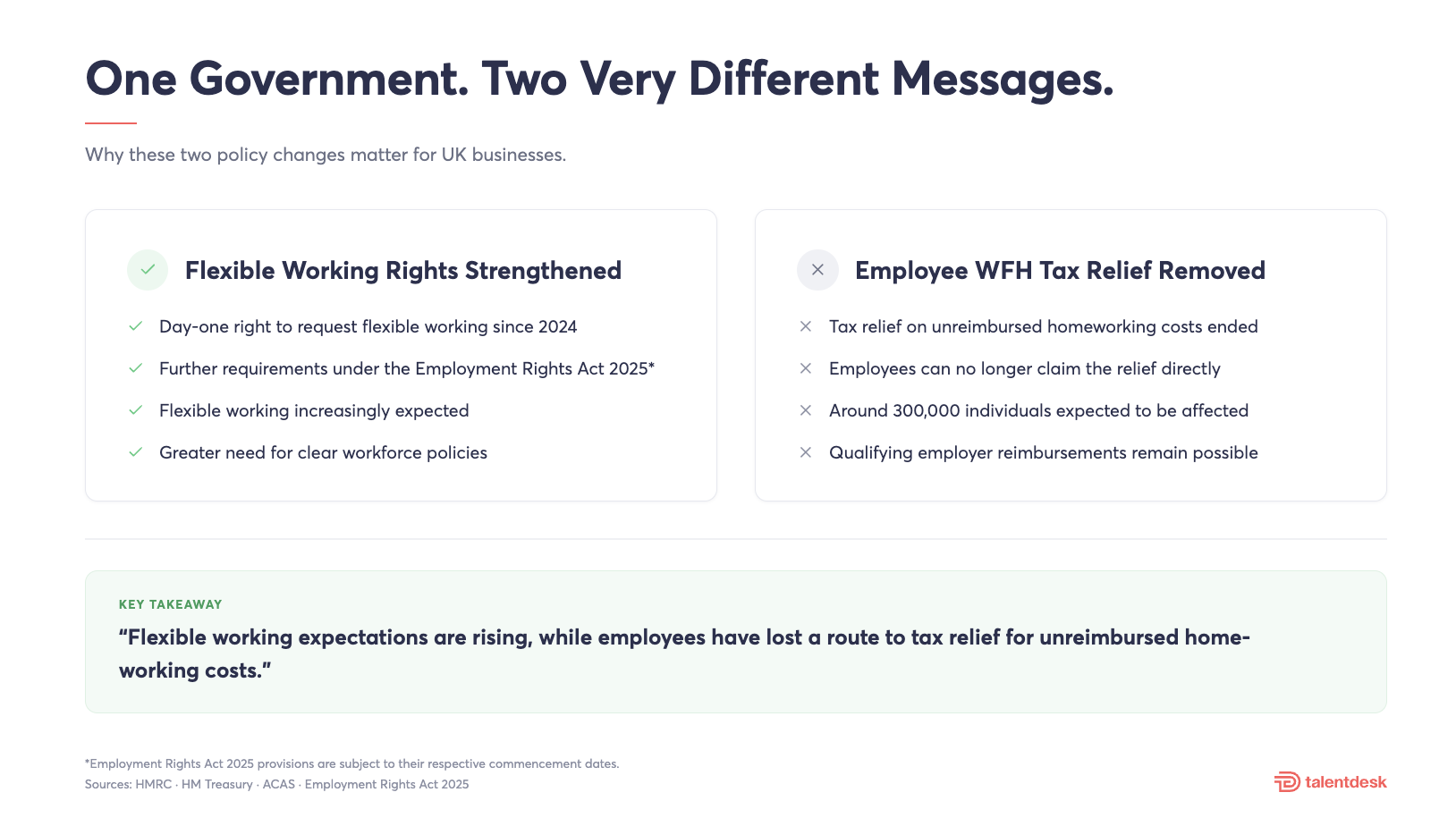
The government's real problem is tax collection.
Everything else follows from that.
I've said this before and I'll say it again: the definition of employment and self-employment was designed when people physically clocked in with a card. Much of the framework around employment status still reflects assumptions from a completely different era. Some of these categories haven't been seriously rethought since before the internet existed.
The system hasn't been redesigned. It has been patched. And what this latest change reveals is something I've long believed: in my view, the government's primary concern has always been whether it can collect taxes efficiently. Not employment philosophy. Not worker protection. Tax collection. That's what I think drives most of these decisions.
PAYE is easy. One payroll log, deductions at source, everything clean. A workforce of contractors who file their own taxes is harder to police. So a question that begins with the commercial reality of how two parties work together becomes entangled in an increasingly complex framework of tax rules, employment rights and classification tests. And that’s where the mess starts.
The WFH tax relief wasn't abolished because remote working is bad policy. According to HM Treasury’s Budget 2025 projections, removing the relief is expected to generate approximately £115 million in additional tax revenue over five years, including £25 million in 2030–31 alone. The rationale offered, that it was difficult to police, is telling. It wasn't difficult to give. It became difficult when too many people started claiming it.
What this actually means for the workforce
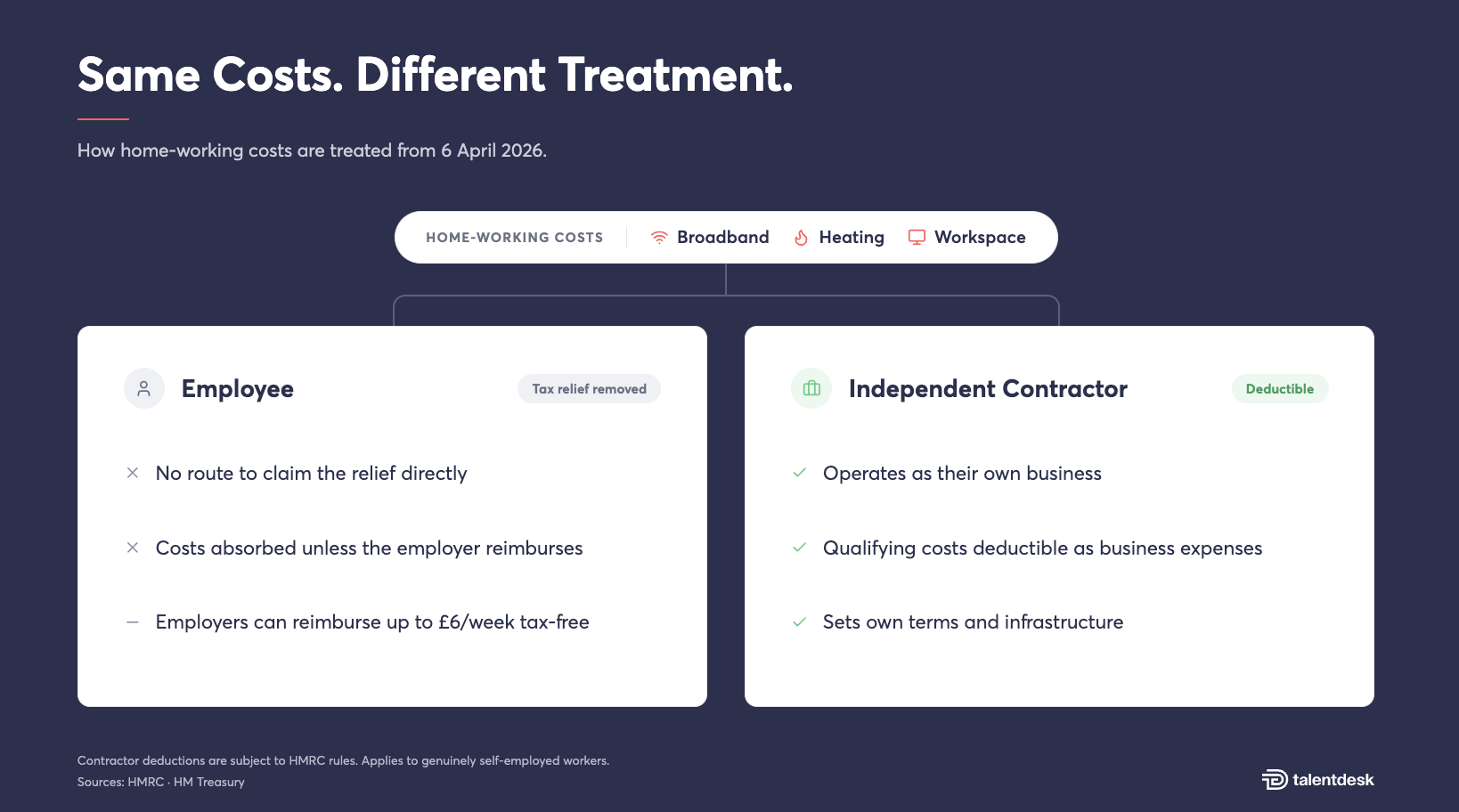
Here's what didn't change when the relief was abolished: the costs.
Broadband, heating, a functional workspace. If you're an employee, those costs just became yours to absorb, unless your employer decides to cover them through expenses. They can still reimburse up to £6 per week tax-free. Whether most will do that proactively is a different question.
For genuinely self-employed workers, the position is different. Qualifying home-working expenses can generally be deducted as business costs, subject to HMRC rules. That’s one of the structural advantages of self-employment that the tax system still acknowledges: running a business from your home can be treated as a legitimate business expense, rather than purely a personal cost.
I think this distinction will start to matter more as people do the maths. The Employment Rights Act 2025 builds on existing protections around flexible working. But protection and cost are different things. An employee now has a legal right to request flexible working. But employees no longer have the same route to claiming tax relief directly for additional home-working costs.
Contractors do.
What this means for businesses
The Employment Rights Act 2025 is the bigger operational development here. For UK businesses, flexible working has increasingly become an expectation rather than an exceptional benefit. The Act introduces further requirements around how employers consider and justify refusals of flexible working requests, with implementation dependent on the relevant commencement dates. Businesses need to understand both their existing obligations and the changes coming into force.
That means more complexity in how you manage your workforce, regardless of headcount. People working across locations and schedules, expecting flexibility as a baseline, with compliance obligations that grow with it.
This shift is part of a much broader transformation in how businesses engage talent, as explored in our article on freelancing and the future of work.
This is the environment in which the distinction between employees and contractors matters more, not less.
Properly engaged independent contractors operate under a different legal framework altogether, one with different rights and different obligations on both sides. A well-structured contractor agreement reflects a genuinely different commercial relationship. The contractor operates as their own business. They manage their own costs, negotiate their own terms, and set up their own infrastructure.
| For UK businesses, the distinction also has practical implications under IR35. Where the off-payroll working rules apply, organisations must assess the working relationship and document their employment status decisions.
|
If your business is engaging independent contractors, having a structured onboarding process is essential to ensure correct classification, contracts and compliance. Read our Ultimate Guide to Freelancer Onboarding to see the six-stage framework.
That's not a workaround. It's how the market has always functioned at its edges. What I'm seeing now is the middle of the market moving in that direction too.
Why this matters to how I think about TalentDesk
I built TalentDesk because customers were telling me that finding freelancers wasn't their real problem. The problem was managing the ones they already had. Everything was on spreadsheets and email threads. Invoices would arrive with no project description. Nobody knew if work had been approved or was within budget. Classification decisions were being made without enough information. I heard that story a dozen times from different companies before I decided it was worth building something around.
The world I'm describing now, a workforce that is more distributed, more flexible, and more contingent than permanent, is exactly the one TalentDesk was built for. Getting contracts right, managing classification carefully, running payments across currencies and jurisdictions, building a complete record of who you've worked with and what you owe them: that's the infrastructure that makes this way of working operationally viable rather than operationally painful.
For businesses expanding internationally, Agent of Record (AOR) services can simplify contractor compliance, contracts and payments.
The government has strengthened flexible working rights. These policy changes may also lead businesses to reassess how they balance permanent employees and independent contractors. Businesses that build the right infrastructure around both will be well placed for what comes next. The ones that don't will find that compliance and admin fill the space where productivity should be.
That's why we built TalentDesk. And it's why we keep building it.
Sources: UK WFH tax relief abolition: TaxAssist, NHS Employers, Remote Work Europe. Employment Rights Bill: ACAS and GOV.UK.
For the 300,000 affected individuals: HMRC
For the £115 million Treasury projection: HM Treasury
For flexible working rights: ACAS

Xenios Thrasyvoulou
Born on labour day, Xenios has been tasked by cosmic forces to disrupt the labour market. He started PeoplePerHour in mid-2007, and TalentDesk.io 10 years later in 2017. When not working (which isn’t very often), he blogs, paints, visits art galleries, cooks a messy meal (more often than not too close to burning his place down), plays sports or watches movies. He holds an MA & MEng from the University of Cambridge and did a short stint at Harvard Business School – enough to convince him never to do an MBA!
See how TalentDesk manages your contractor workforce
Related articles

Behind the Runway: Managing Fashion Week’s Global Contractor Workforce
Fashion Week contractor management made simpler. Manage global freelancers, vendors, contracts, compliance, invoices and payments.


When Contractor Management Breaks: 5 Signs You've Outgrown It
Has your contractor management process stopped scaling? Discover 5 warning signs, what breaks as contractor teams grow, and when it's time to upgrade.

How to Legally Onboard Freelance Workers in Any Country (2026 Guide)
Learn how to legally onboard freelance workers in any country. What changes by jurisdiction across classification, contracts, tax, and data privacy.


AI and Compliance: What Companies Need to Know When Using AI to Manage Contractors
Using AI in contractor management comes with real compliance risks. Discover how to stay on the right side of IR35, the EU AI Act, and classification laws.

C2C vs 1099 workers: What's the Difference and Which Should You Engage?
Learn the key differences between 1099 and C2C workers, including tax implications, liability, and how to choose the right contractor for your needs.

Best Contractor Compliance Software in 2026: 7 Tools Compared
Compare the best software for contractor compliance in 2026, including TalentDesk, Deel, Remote and more. Find the right platform for your workforce.

What is Changing In International Employment Law in 2026–2028?
Prepare for international employment law changes in 2026–2028, including AI governance, pay gap reporting, contractor compliance and workforce risks.

Compliance in Vendor Management
Ensure safe vendor partnerships with a third-party compliance strategy. Learn key regulations, audit steps and how TalentDesk simplifies vendor management.

Vendor Risk Management – How to Identify, Assess & Control Third-Party Risks
Proactive Vendor Risk Management is key to preventing compliance & financial issues. Learn how to assess, score and mitigate vendor risks effectively.

Contract Management in Vendor Relationships
Learn how to manage vendor contracts effectively, from key clauses and negotiation tips to lifecycle best practices that reduce risk and boost performance.