

Content
- Why International Contractor Payments Are Different
- Before You Pay: Build the Compliance Foundation
- Ways to Pay International Contractors
- How Do You Choose the Best Way to Pay International Contractors?
- The International Contractor Payment Workflow
- Currency, FX and the True Cost of Payment
- Best Practices for Paying International Contractors
- What to Look for in an International Contractor Payment Platform
- The Bottom Line
- Frequently Asked Questions
Businesses can pay international contractors through bank transfers, specialist money-transfer services, digital wallets or dedicated contractor payment platforms. The best method depends on the contractor’s location, payment frequency, currency, fees and compliance requirements. For businesses managing contractors across multiple countries, connecting onboarding, work approvals, invoicing and payments in one workflow can reduce administrative complexity.
When you pay overseas contractors, the transfer itself is the final step. Before that, you need a workflow that handles classification, contract, tax information, invoice approval, identity checks and payment details. Without this, every additional currency, legal entity and payment schedule creates new possibilities for delays and hidden costs.
Disclaimer: This article provides general operational information, not legal or tax advice. Requirements vary by payer location, contractor location and engagement structure.
|
TL;DR
|
Why International Contractor Payments Are Different
A domestic payment involves just one banking landscape, currency and regulatory environment. An international payment is significantly more complex. It involves factors like:
- Worker location and the currency the contractor will be paid in. The more widely spread your contractor workforce, the more complex it gets.
- The payer entity that will process the payment, whether it’s your company headquarters, the local entity in each location, or an AOR service.
- Contract currency – the currency of payment that has been agreed upon in your contract.
-
Settlement currency is the currency the contractor actually receives. It may differ from the contract currency, depending on the payment method and agreed terms. Currency conversion may apply.
-
Foreign exchange (FX) conversion or the value of one currency when converted to another. This changes day to day, as per market forces.
-
Banking rails are the payment networks and systems used to transfer funds between financial institutions. Different payment methods use different networks, which can affect settlement times, fees and availability.
-
Bank identification and routing codes help identify the receiving bank or account. Depending on the country and payment method, these may include SWIFT/BIC, IBAN, IFSC or local routing numbers.
- Intermediary fees might be involved in case a third party bank or entity is required to route the transfer. This happens if your bank doesn’t have a direct relationship with the receiver bank.
-
Sanctions screening helps identify whether payments involve restricted individuals, organisations or jurisdictions. Payment providers may perform these checks, but businesses should understand their own obligations and confirm which controls their provider applies.
- Tax documentation and reporting protocols that you may need to comply with. Although contractors typically pay their own taxes, you may have to report the payments you make to them. In some regions, you may even have withholding responsibilities.
International contractor payments are typically managed through commercial agreements and invoices rather than employee payroll. Payment amounts may be fixed, milestone-based or variable, while tax and reporting obligations depend on the relevant jurisdictions and engagement structure.
Additionally, the rules, regulations and responsibilities change across countries. Where a contractor physically performs the work from can change your tax and reporting obligations.
UK businesses can refer to guidance from the Office of Financial Sanctions Implementation for information about UK financial sanctions requirements.
Before You Pay: Build the Compliance Foundation
There are some pre-payment processes that you will need to follow. These differ from country to country, so ensure the specific rules are assessed by your HR, legal, finance and accounts teams.
Confirm worker classification
Verify that the professional you are engaging is indeed an independent contractor as per the relevant jurisdiction’s laws. If they are classified as employees, your payment obligations completely change.
An agreement is not sufficient proof that they are contractors. Assess the worker’s status against applicable classification rules and document the reasoning where required or appropriate. Reassess their status if the scope, duration, location or working arrangements change.
For UK engagements, businesses can consult HMRC's employment status guidance, while recognising that other jurisdictions apply different classification rules.
Put the commercial terms in writing
The key commercial and payment terms should be clearly documented in a signed agreement or Statement of Work (SOW).
This includes:
- The parties involved
- What services the worker will deliver
- How those services will be charged (hourly rates, project rates or something else)
- The contract currency
- How exchange rates and transfer costs will be handled
- The payment timelines – frequency, milestones and deadlines
- Tax responsibilities and reporting obligations
- Termination clauses by which payments can legally be stopped
Many of these factors vary greatly based on the country, so ensure the agreements are jurisdiction-appropriate. For more detailed guidance, see our guide to legally onboarding freelance workers in any country.
Collect the right information securely
Collect the information needed for onboarding and payment processing before the first payment is due, allowing sufficient time for any required verification.
-
Verify the contractor’s identity and relevant business details. Determine whether additional KYC, anti-money laundering or sanctions-screening requirements apply to your organisation, payment provider or transaction. The worker may need to fill out specific forms or declarations as per the jurisdiction.
-
Collect only the information necessary for the relevant purpose and retain it in accordance with applicable data protection requirements.
- Check your tax reporting and withholding obligations, and collect the worker’s tax identification number or forms that you will subsequently need. If any indirect taxes (like VAT, GST or equivalent) apply, collect details around that as well.
- Verify the worker’s bank information, recording their country, currency and transfer codes.
Establish the invoice and approval route
Let the contractor know how and by when they should submit invoices, and what details, reference numbers or project codes they must include. Communicate who holds the approval authority and what approval deadlines will be followed.
Ways to Pay International Contractors
Payment method |
Advantages |
Limitations |
Best fit |
International bank transfer |
|
|
|
Specialist money-transfer service |
|
|
|
Digital wallet or online payment account |
|
|
|
Accounting or accounts-payable software |
|
|
|
Contractor management and payment platform |
|
|
|
Agent or Contractor of Record service |
|
|
|
The right payment method depends on contractor volume, geographic coverage, payment frequency, total transaction costs and the level of administrative or compliance support required.
How Do You Choose the Best Way to Pay International Contractors?

The best international contractor payment method depends on how many contractors you manage, where they are based, how frequently you pay them and how much administrative support your business needs.
For occasional payments to a small number of contractors, international bank transfers or specialist transfer services may be sufficient.
For businesses managing recurring payments across multiple countries, contractor management platforms can help connect onboarding, approvals, invoicing and payments in one workflow.
Where contractor classification, contracting or local compliance requirements are more complex, businesses may also consider Agent of Record or Contractor of Record services.
Before selecting a provider, compare supported countries and currencies, total payment costs, settlement times, compliance support, integrations and reporting capabilities.
The International Contractor Payment Workflow
Here’s what the end-to-end workflow should cover:
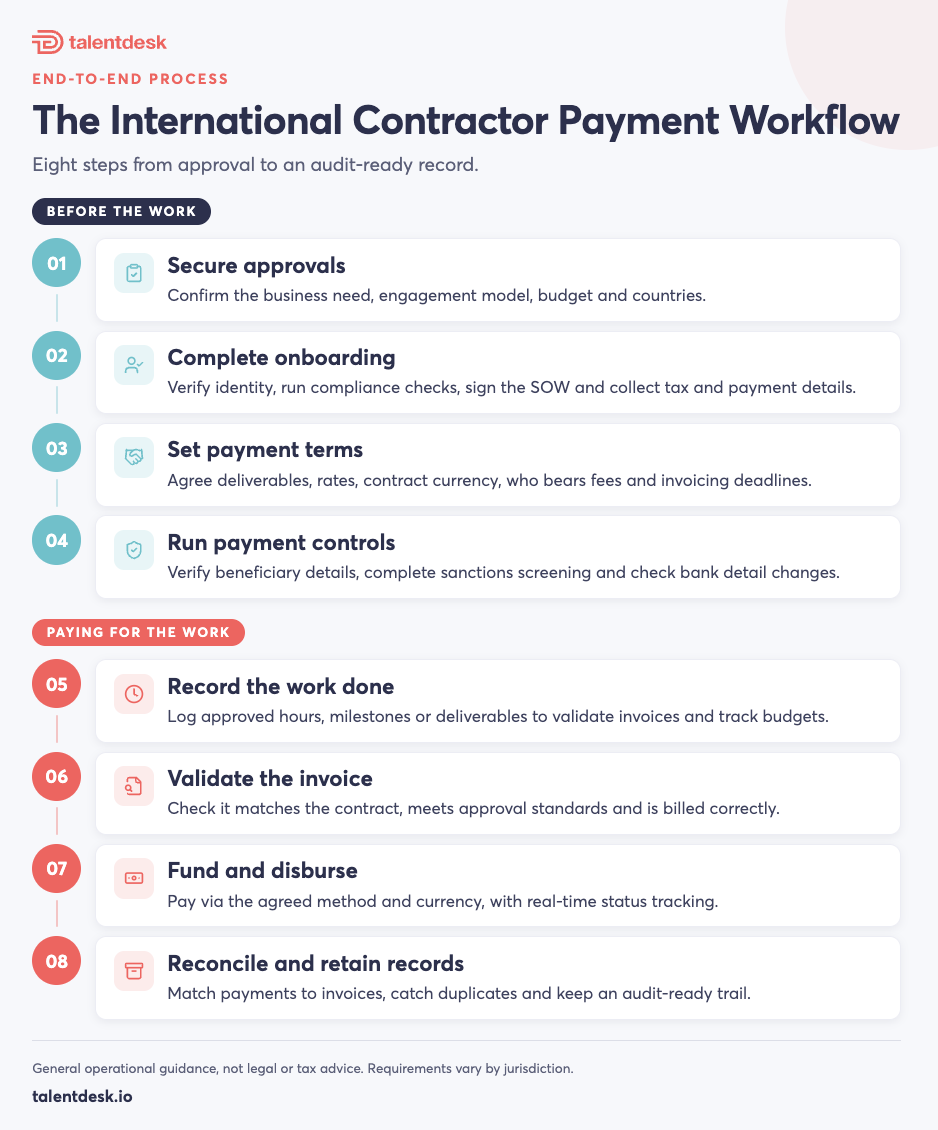 International contractor payment workflow: eight steps from initial approval to payment reconciliation.
- Secure approvals
Get internal buy-in for the business need, the type of worker you want to engage, and the engagement model. Establish your budgets and which countries you want to engage workers in. - Complete onboarding
Verify the contractor’s identity and relevant business details, complete any applicable compliance checks, sign the agreement or SOW, and collect the necessary tax and payment information.
- Set payment terms
Agree upon the payment terms – what will be delivered, how it will be charged and the amount to be paid upon completion. Communicate what contract currency you will follow and who will bear any fees or charges. Also agree upon invoicing protocols, approval deadlines, payment milestones and processing timelines. - Run payment controls
Verify beneficiary details and payment instructions before processing the transfer. Complete any required sanctions screening and establish additional verification procedures for changes to bank account details.
- Record the work done
Record the approved hours, milestones or deliverables relevant to the contractor’s payment terms. Timesheets, worksheets or project approvals can help validate invoices and monitor budgets. This also gives you early visibility around budget usage and possible overshoots.
- Validate the invoice
Confirm if each invoice aligns with what was agreed in the contract. Verify that the work meets the approval standards and is billed to the correct project and entity. - Fund and disburse
Process the payment as per the agreed method and currency. A payment tracker that updates status in real time offers visibility to everyone involved. - Reconcile and retain records
Match the amount paid to the invoice, ensuring that there are no errors or duplicate payments. This also helps you maintain an audit-ready trail.
Currency, FX and the True Cost of Payment
Suppose a US business needs to pay a contractor $1,000, with the payment converted into euros.
The final amount received depends on the exchange rate applied and any additional transfer charges.
Example: How FX fees affect contractor payments
|
Payment component |
Amount |
|---|---|
|
Contractor invoice |
$1,000 |
|
Illustrative market exchange rate |
€0.86 per $1 |
|
Amount before fees |
€860 |
|
Illustrative FX markup (2%) |
−€17.20 |
|
Illustrative transfer fee |
−€5 |
|
Final amount received |
€837.80 |
Illustrative example only. Actual rates and fees depend on the provider, currencies and payment method.
Before choosing international contractor payment methods or providers, find out what conversion rates they offer and what deductions will be involved. Also consider the cost of manually processing, approving and reconciling each payment.
These can add up to significant amounts. You may find that a transfer route that initially seemed cheap actually ends up being more expensive. A platform that eases these factors may be the better option.
Best Practices for Paying International Contractors
- Align: Agree on all the payment terms before work begins. Inform contractors about which currency they will receive and which fees may apply.
- Verify: Missing documentation or incorrect bank details are a key cause for delayed payments. Prevent this by validating beneficiary details during onboarding.
- Streamline data: Use one contractor record for contracts, tax information and verified payment details to avoid data fragmentation.
- Minimize bottlenecks: Separate the person approving work from the one releasing funds where possible. Set escalation protocols so payments don’t stop if a manager is absent.
- Manage risks: Use a two-person verification process if beneficiary bank details need to be updated.
- Create visibility: Let contractors view payment status in real time to minimize follow-ups. But ensure they know whom to approach for support in case of exceptions or payment failures.
- Track and assess: Reconcile every payment to the approved invoice, project and cost center. Measuring metrics like failure rate, average resolution time and manual interventions needed per invoice tells you how effective your system is.
What to Look for in an International Contractor Payment Platform
As your contractor workforce expands across countries, currencies and payment schedules, manual processes can become harder to manage. A dedicated contractor payment platform can help centralise onboarding, approvals, invoicing and payment records. Recurring invoice backlogs, payment errors and fragmented contractor records may indicate that a dedicated platform would improve efficiency and visibility.
The ideal platform should give you a workflow that connects approved work to consolidated invoices, payment and reconciliation. It should offer:
- Coverage in the relevant country and currency you want to pay in.
- Transparency around FX pricing and transfer fees.
- Compliant handling of payment information and personal details.
- KYC, AML and sanctions-control support.
- Contractor onboarding and document management capabilities.
- Worksheet, milestone or deliverable approval workflows.
- Consolidated invoices and multi-entity support.
- Customized approval permissions and payment controls.
- Budget, accrual, expense and invoice reporting capabilities.
- Integrations with your accounting or ERP software.
- Capabilities to track and manage exceptions when required.
- Audit-ready record keeping, from engagement through payment.
TalentDesk brings contractor onboarding, document management, work approvals, invoicing and international payments into one external workforce management platform.
For businesses managing multiple contractors, its consolidated invoicing capabilities can reduce the need to process individual invoices separately. Teams can also use worksheet approvals and budget controls to maintain visibility over contractor activity and spending.
Accounting integrations can help streamline reconciliation and maintain clearer payment records for reporting and audits.
By connecting contractor management with payment workflows, TalentDesk helps businesses reduce manual administration while maintaining greater visibility across their external workforce.
The Bottom Line
Paying international contractors reliably involves more than choosing a transfer method. Businesses need a consistent process for classification, contracts, tax documentation, work approvals, invoicing, payment controls and reconciliation.
The best payment route is not necessarily the one with the cheapest transfer fees. It’s the one that ensures your contractors are paid predictably, while maintaining compliance, consolidating records and scaling without multiplying manual work.
____________________________________________________________________________
Simplify International Contractor Payments
Manage contractor onboarding, work approvals, consolidated invoicing and international payments in one platform.
Explore Global Freelancer Payments

Sanhita Mukherjee
Sanhita’s experience in the freelancer industry is evident in her role as one of our dedicated content and copy writer at TalentDesk, where she leverages her knowledge and over 10 years of experience to educate others about freelancer management.
Simplify International Contractor Payments
Related articles

TalentDesk vs Rippling (2026): Which Platform Is Right for You?
Compare TalentDesk vs Rippling in 2026. Explore contractor management, compliance, global payments, project tracking, pricing and key differences.


The Ghost Contractor Problem: How Inactive Workers Keep Costing You
Ghost contractors create unnecessary costs, security risks and compliance headaches. Learn how to identify inactive contractors and improve contractor offboarding.


TalentDesk vs Worksuite (2026): Which Platform Is Right for You?
Compare TalentDesk vs Worksuite for contractor management, compliance, global payments and pricing. Find the right platform for your external workforce.

Behind the Runway: Managing Fashion Week’s Global Contractor Workforce
Fashion Week contractor management made simpler. Manage global freelancers, vendors, contracts, compliance, invoices and payments.

When Contractor Management Breaks: 5 Signs You've Outgrown It
Has your contractor management process stopped scaling? Discover 5 warning signs, what breaks as contractor teams grow, and when it's time to upgrade.

TalentDesk vs Remote: A Contractor Management Platform Comparison
TalentDesk vs Remote: a contractor management platform comparison covering compliance, payments, vendor visibility, and pricing.

The Best Vendor Management Systems (VMS) in 2026
The best vendor management systems (VMS) in 2026, compared by use case, workforce type, and features. Find the right platform for vendors and spend.

Contingent Workforce 101: What It Is, Why It's Growing, and How to Get It Right
Contingent workforce management 101: classification, contractor compliance, and workforce visibility — what it takes to run one program, not ad hoc hiring.

How to Legally Onboard Freelance Workers in Any Country (2026 Guide)
Learn how to legally onboard freelance workers in any country. What changes by jurisdiction across classification, contracts, tax, and data privacy.

AI and Compliance: What Companies Need to Know When Using AI to Manage Contractors
Using AI in contractor management comes with real compliance risks. Discover how to stay on the right side of IR35, the EU AI Act, and classification laws.