

Content
- The People Who Show Up Without Being Asked Twice
- The Businesses That Treat Contractors Well
- The Infrastructure That Removes the Friction
- The Contractors Who Built Something for Themselves
- What All of This Points To
- Frequently Asked Questions
There is a tradition to Thanksgiving that most people recognize even if they have never celebrated it. You stop. You take stock. You name, out loud, the things that are easy to take for granted.
In the world of external workforce management, there is quite a lot worth naming.
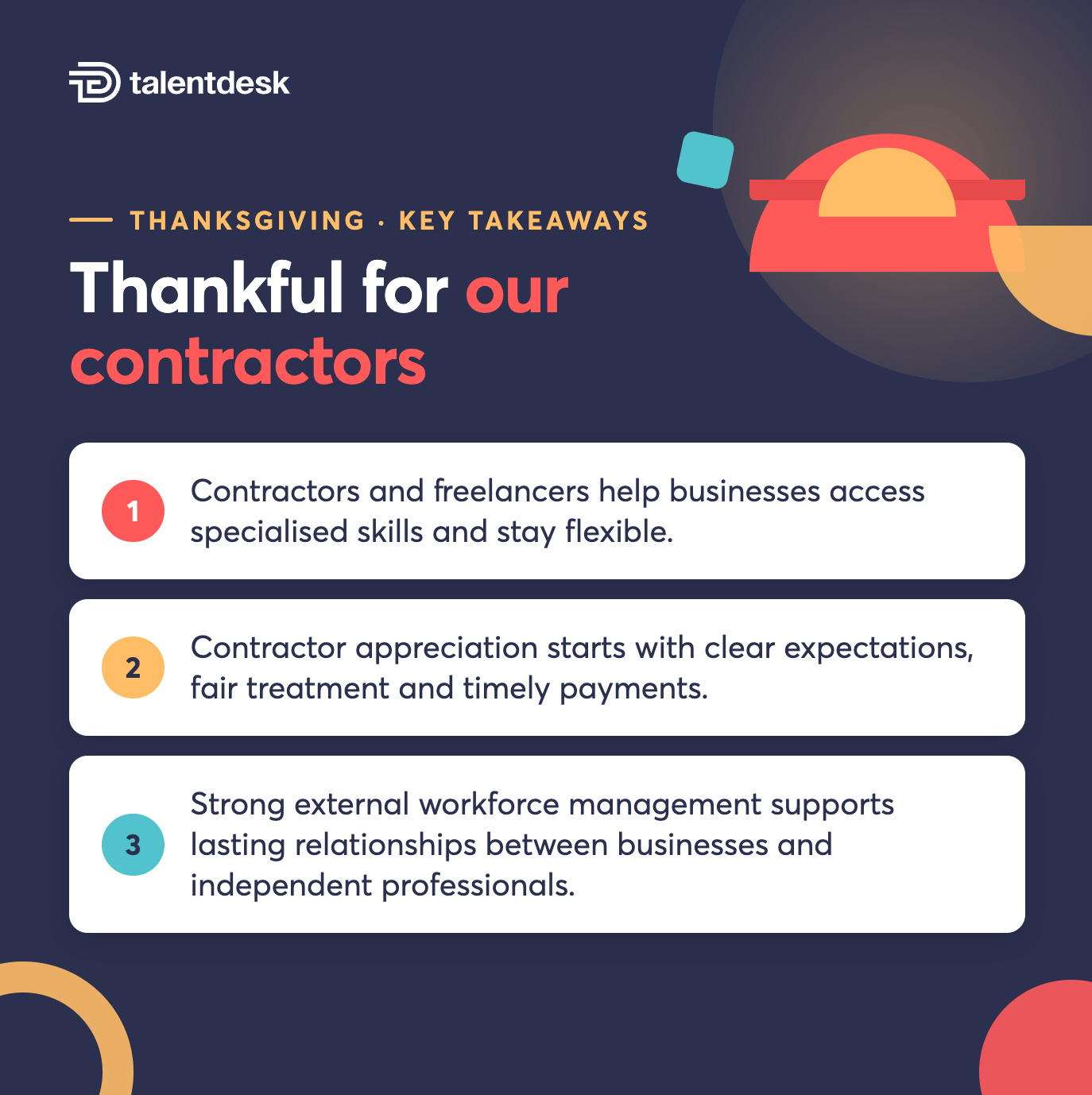
The People Who Show Up Without Being Asked Twice
Somewhere right now, a contractor is delivering a project without needing a meeting to explain what good work looks like. A freelance developer is shipping a fix that the internal team did not have bandwidth to reach. A consultant is walking into a room with the expertise that took years to build and three weeks to engage.
These are the people who make businesses flexible enough to respond when it matters. Not because flexibility is a buzzword, but because real operational flexibility requires real people who are genuinely good at what they do, available when you need them, and trusted to work without hand-holding.
We are thankful for them.
Not in a performative way. In the way you are thankful for something that only becomes fully visible when you imagine the alternative.
The Businesses That Treat Contractors Well
There is a version of contractor engagement that is transactional to the point of being extractive. Late payments. Vague scopes. Contracts that protect one side. Onboarding processes that treat experienced professionals like a form to be filed.
And then there is the other version. The businesses that pay on time, every time. That give contractors a clear brief and then trust them to execute it. That offboard cleanly and keep the door open for the next project. That understand a contractor's reputation is built on the same work their client's reputation is built on.
Those businesses get better work. They get contractors who go beyond the brief because the relationship is worth going beyond the brief for. They build talent pools that return every year because the experience was worth returning to.
We are thankful for the businesses that have figured this out. And we are genuinely glad to work with them.
The Infrastructure That Removes the Friction
Good intentions do not pay invoices. A contractor who is appreciated but paid 60 days late does not feel appreciated. A business that values its external workforce but loses their tax documentation in a shared inbox is not actually managing them well.
The unglamorous truth about external workforce management is that the relationship between a business and its contractors is only as good as the operational infrastructure supporting it. Classification handled correctly from the start. Contracts that are signed, stored, and retrievable. Invoices approved without chasing. Payments that arrive when expected.
We are thankful that the tools to do this well exist.
That businesses no longer have to choose between scale and control. That the processes which used to require a dedicated team of specialists can now be built into a platform that runs in the background, predictably, while everyone gets on with the actual work.
The Contractors Who Built Something for Themselves
There is something worth acknowledging about the people who chose the independent path. Who decided that trading stability for autonomy was the right calculation for their lives. Who built a business from their own expertise, managed their own client relationships, navigated their own compliance obligations, and made it work.
That choice is not for everyone. It takes a particular kind of confidence and discipline. And it creates a category of worker that brings something to a client engagement that an employee rarely can: genuine ownership. The contractor who delivers is delivering something they put their name on, not something they were assigned.
We are thankful for that ownership. It raises the standard.
What All of This Points To
External workforce management is easy to frame as a compliance problem, a payments problem, or an operational efficiency problem. And it is all of those things.
But at its core, it is a people problem in the best sense of that phrase. It is the challenge of building relationships with skilled individuals and teams who are not on your payroll, across countries and time zones and legal frameworks, in a way that works for everyone involved.
The businesses that solve it well do not just avoid the compliance penalties and the payment delays. They build something genuinely valuable: a network of people who want to work with them again.
That is worth being thankful for.
TalentDesk helps businesses manage their external workforce compliantly and at scale, from onboarding and classification through to consolidated global payments. See how it works.
See how TalentDesk manages your external workforce

Xenios Thrasyvoulou
Born on labour day, Xenios has been tasked by cosmic forces to disrupt the labour market. He started PeoplePerHour in mid-2007, and TalentDesk.io 10 years later in 2017. When not working (which isn’t very often), he blogs, paints, visits art galleries, cooks a messy meal (more often than not too close to burning his place down), plays sports or watches movies. He holds an MA & MEng from the University of Cambridge and did a short stint at Harvard Business School – enough to convince him never to do an MBA!
See how TalentDesk manages your external workforce
Related articles

How to Pay International Contractors: Methods, Compliance and Best Practices
Learn how to pay international contractors, compare payment methods, manage compliance, reduce FX fees and streamline global contractor payments.


TalentDesk vs Rippling (2026): Which Platform Is Right for You?
Compare TalentDesk vs Rippling in 2026. Explore contractor management, compliance, global payments, project tracking, pricing and key differences.

The Ghost Contractor Problem: How Inactive Workers Keep Costing You
Ghost contractors create unnecessary costs, security risks and compliance headaches. Learn how to identify inactive contractors and improve contractor offboarding.


TalentDesk vs Worksuite (2026): Which Platform Is Right for You?
Compare TalentDesk vs Worksuite for contractor management, compliance, global payments and pricing. Find the right platform for your external workforce.

The Ultimate Guide to Freelancer Onboarding in 2026
Learn how to onboard freelancers with a scalable process covering compliance, contracts, payments, onboarding checklists and international best practices.

Behind the Runway: Managing Fashion Week’s Global Contractor Workforce
Fashion Week contractor management made simpler. Manage global freelancers, vendors, contracts, compliance, invoices and payments.

When Contractor Management Breaks: 5 Signs You've Outgrown It
Has your contractor management process stopped scaling? Discover 5 warning signs, what breaks as contractor teams grow, and when it's time to upgrade.

TalentDesk vs Remote: A Contractor Management Platform Comparison
TalentDesk vs Remote: a contractor management platform comparison covering compliance, payments, vendor visibility, and pricing.

The Best Vendor Management Systems (VMS) in 2026
The best vendor management systems (VMS) in 2026, compared by use case, workforce type, and features. Find the right platform for vendors and spend.

Contingent Workforce 101: What It Is, Why It's Growing, and How to Get It Right
Contingent workforce management 101: classification, contractor compliance, and workforce visibility — what it takes to run one program, not ad hoc hiring.